
Most of the leaders we work with are not short on insight. They know their communities. They have listened, closely and for years, and they can tell you exactly what their people need, fear and hope for. What they are short on is a way to turn all of that understanding into a decision they can stand behind.
That gap shows up most sharply at the moment of growth. A new funding stream opens. A government tender appears that would double the budget. A board, watching the numbers, starts asking why the organisation is not scaling. And the question quietly shifts from “what do our people need” to “who do we want to become, and what are we willing to give up to get there.”
For a values-led organisation, growth is never neutral. Every expansion carries a cost to mission, control or focus that a purely commercial business would not feel in the same way. Choosing well in that situation is hard, and most of the tools on offer are not built for it.
Insight is not strategy
There is a comfortable belief in the sector that if you understand your community deeply enough, the right strategy will simply become obvious. It will not. Insight tells you what is true. Strategy is what you choose to do about it, and choosing means leaving things behind.
We see organisations sidestep that choice in a few familiar ways:
- They design services before they have decided what the services are for.
- They reach for consensus, which usually lands on the option that offends nobody and commits to nothing.
- They borrow a generic growth framework built for a product company and quietly bend their mission to fit it.
- They treat funding as if it were free money, rather than a force that reshapes what they do.
- They mistake being busy for having a direction.
The CoLab Strategic Translation Method™ exists to close that gap. It is a structured way of moving from deep empathy to a small number of strategic options that are coherent, defensible, and honest about their trade-offs. The rest of this piece is really about one idea:
A good strategy is not something you have. It’s something you have chosen.
What this looks like in practice
Consider a composite of organisations we have worked with. A peer-led mental health service, started by people with lived experience, trusted by its community precisely because it does not feel clinical. It is small, well loved, and chronically underfunded.
A large multi-year government contract comes up. Winning it would triple the budget, reach far more people, and end the annual scramble for grants. It would also require standardised clinical reporting, a workforce built around accredited professionals, and a way of operating that the founding community would barely recognise.
Here is where the method earns its keep. The empathy work has already surfaced something true: people come to this service because it is run by people like them, and that trust is the thing that makes it work at all. Translate that into a strategic truth and it becomes a constraint. If the peer voice is diluted, the very thing that draws people in starts to erode.
Now the tension is visible, and it is not a problem to be solved. It is a genuine fork. Reach and stability sit on one side. Fidelity to the peer model and community ownership sit on the other. You cannot fully have both.
From that single tension, two coherent options take shape.
- Option one: become the trusted scale provider. Take the contract. Grow into a significant service that reaches thousands rather than hundreds, with the financial stability to plan beyond the next funding cycle. The cost is real and named up front: the peer model becomes one ingredient among several rather than the whole identity, some founding members will feel the organisation has moved past them, and the work of protecting culture at scale never really ends.
- Option two: stay small and stay sovereign. Decline the contract on its current terms. Protect the peer-led model in full, keep ownership close to the community, and accept that the organisation remains modest in size and exposed to the funding cycle. The cost here is also named: fewer people reached, ongoing financial fragility, and the quiet knowledge that you turned down the chance to help more.
Notice that neither option is comfortable. That is the point. If every option on the table feels easy or appealing, the work has not gone far enough. A real strategic choice should cost the organisation something, and the leaders making it should be able to see clearly what that something is.
The four stages, briefly
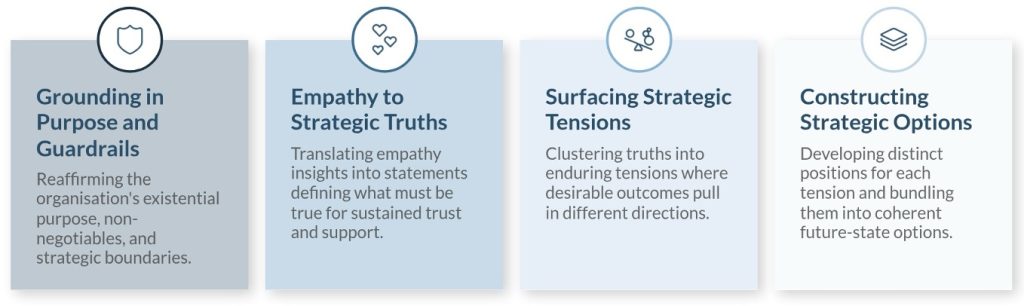
The method moves through four stages, and the example above runs straight through all of them.
- Grounding in purpose and guardrails. Before anything else, the organisation reaffirms why it exists and for whom, names its non-negotiables (safety, equity, community trust), and sets the boundaries of what is out of scope. Everything that follows happens inside those lines.
- Empathy to strategic truths. The insights from listening are translated into statements about what must hold for trust, legitimacy and support to last. These are the real constraints the organisation has to work within.
- Surfacing strategic tensions. Those truths cluster into a small number of enduring tensions, the places where two good things pull against each other and cannot both be fully satisfied. Depth of impact against scale of reach. Community control against funder accountability. Stability against innovation.
- Constructing strategic options. For each tension, the organisation explores the positions it could take, then bundles the compatible ones into a few coherent options. Each option is spelled out in full: the role it commits the organisation to, the value it creates, the trade-offs it accepts, how it pays for itself, and what it deliberately lets go of.
What you are left with
At the end, an organisation is not holding a single recommended answer handed down by consultants. It is holding a short set of distinct, credible options, a shared and honest understanding of the tensions it faces, and real clarity about what each path would require and risk.
That is a strong foundation for the next decisions, the ones about business models, funding and implementation. It is also a strategy that holds up in front of a board, a funder or an investor, because the trade-offs were chosen openly rather than glossed over. People tend to trust a plan more when they can see the hard choices behind it.
A conversation worth having
If your organisation is sitting in front of one of these forks right now, with strong values, a real decision to make, and no easy answer, that is exactly the situation this method is built for.
We would be glad to talk it through with you. You can reach us at info@colabstrategy.com.au or Book a free 30-minute strategy session to get clarity about your next steps.
Let’s Chat!
Reach out to CoLab Strategy today to discuss how we can help you grow your organisation for greater impact.